


A trade show booth has about three seconds to make an impression. That’s how long it takes for a visitor walking down the aisle to decide whether to stop or keep going. After more than 25 years and several thousand booths—ranging from 9 square meters at the Kista Fair to 1,200 square meters at the Auto Show—we know what makes the difference. Here are seven things that make a difference, listed in order of greatest impact.
1. Decide what the booth is intended to achieve before you design it
Leads, product launches, client meetings, or recruitment result in four completely different booth designs. A booth for generating leads needs an open front, a counter near the aisle, and something to draw people in. A booth for scheduled client meetings needs private meeting areas and a smaller open space. Write down a measurable goal (number of conversations, scheduled meetings, contacts collected)—it guides every design decision and makes it possible to evaluate the results afterward.
2. Build upward—that’s where people will see you
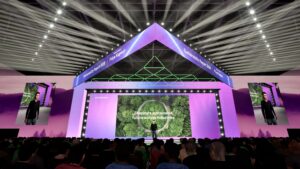
On the exhibition floor, visitors rarely see more than two booths away at eye level. What’s visible above their heads is a hanging sign, a high wall, or an LED screen at a height of 2.5 meters. Check the building regulations for your location—most Swedish trade shows allow [question: 2.5 / 4 m] without special permission—and use the maximum height in at least one part of the booth. A corner or island location provides more sightlines; request it when you make your reservation.
3. Open the front panel
The most common mistake we see is a counter or wall running across the front of the booth. It acts as a threshold. Place the counter along the side or inside the booth, keep at least two-thirds of the front clear, and make sure the floor is level with the aisle or has a clear, low ramp. Visitors will enter where there is nothing to step over.
4. One message, not ten
From the aisle, visitors can read no more than six to eight words. Choose a message for the large surface: what you offer, and for whom. Product sheets, specifications, and partner logos belong inside the booth or on a screen, not on the facade. Try this: take a photo of the 3D sketch, shrink it to mobile size, and see if the message is still legible.
5. Light and moving images catch the eye
Exhibition halls are uniformly and blandly lit. A booth with its own lighting—focused spotlights on products and faces, backlit fabric, or LED strips in the structure—looks more expensive than it is. Moving images on an LED screen attract even more attention, but only if the content is tailored for the trade show: short loops without sound, large text, and no full-length presentations. Expect a 3 × 2 m LED wall with a 2.5 mm pixel pitch to be clearly visible from a distance of three meters.
6. Give visitors something to do
Booths where visitors can try things out, press buttons, taste products, or compete keep people there three times as long as booths where they just look around. It doesn’t have to be anything big: a product to hold, a touchscreen with a configurator, a coffee bar, or a raffle tied to collecting contact information. The important thing is that the activity leads to a conversation with your staff—otherwise, people will just end up drinking coffee.
7. Design the booth for three trade shows, not just one
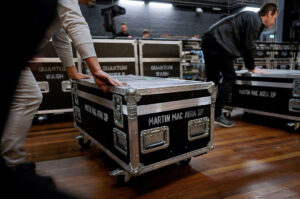
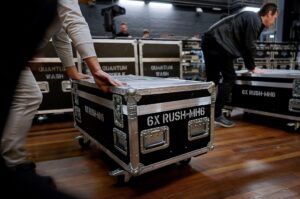
A unique booth becomes expensive if it has to be rebuilt from scratch every time. If you use a modular system like beMatrix, the same framework can be set up as an 18-square-meter booth at one trade show and a 50-square-meter booth at the next, with new graphics but the same structure, lighting, and equipment. The cost per trade show drops by [question: X%], there are fewer shipments, and you don’t have to start from scratch with the design. This is also how we build booths that are used in Stockholm, Milan, and Chicago in the same year.
Frequently Asked Questions
How long before the trade show do we need to start?
For a turnkey booth, we estimate [question: number] weeks from the initial briefing to the trade show, and the trade show’s own deadline for booth design and electrical work is often six to eight weeks before the opening. If you already have a beMatrix framework with us, the process will be faster.
How much does a unique trade show booth cost?
It depends on the floor space, design, equipment , and the number of trade shows where the booth will be used. We tailor the solution to your budget and provide a highly competitive quote—often featuring a modular system that can be reused at multiple trade shows. Tell us about your project, and we’ll discuss the possibilities. Learn more about our trade show booths.
Can we use the same booth at multiple trade shows?
Yes. We store the framework between trade shows, replace the graphics, and rebuild the booth to fit the dimensions of the next venue.
Would you like a 3D sketch of what your next booth might look like? Contact us with the trade show, booth size, and dates.